
Table of Contents
User needs that determine display choice
Corporate event planners and AV integrators require displays that balance image fidelity, reliability, and integration ease; this analysis adopts a user-centric frame to prioritize those needs. Early decisions hinge on platform capabilities such as pixel pitch, refresh rate, and brightness (nits), and on how content pipelines map to hardware. Practical demonstrations at CES in Las Vegas have repeatedly shown how a well-configured Micro LED display can transform stage presence; similarly, when stages demand curvature or conformability, a flexible micro led display becomes a decisive option. The following sections treat selection, deployment, and post-install calibration as a continuum rather than isolated tasks.
Performance metrics that matter to users
For corporate stages the three primary metrics are spatial resolution (expressed via pixel pitch), color fidelity (color gamut and HDR handling), and temporal performance (refresh rate and input lag). Specify pixel pitch relative to audience distance to avoid overspending on unnecessary resolution. Expect typical brightness requirements between 1,000–6,000 nits depending on ambient lighting. Include driver IC capability and module interchangeability as procurement criteria; these influence serviceability and long-term uptime.
Design considerations for flexible micro led display systems
System design must integrate mechanical mounting, thermal management, and signal distribution. Flexible modules reduce structural framing and allow custom curvature, but they impose tighter calibration regimes and stricter tolerance on viewing angle. Plan for front-end content handling: pixel mapping, media servers, and color calibration workflows must align with the display’s module topology. Calibration routines should measure and adjust per-module luminance and color temperature to maintain consistent HDR playback across seams.

Implementation pitfalls and common mistakes
Several recurring errors degrade outcomes: misjudged pixel pitch, inadequate power provisioning, and insufficient service access. Many projects underestimate the impact of refresh rate on fine motion; a nominal 3,840 Hz refresh may be required for camera-friendly broadcast. Avoid buying solely on peak brightness—sustained luminance and cooling determine long-term performance. Integrators sometimes neglect content scaling and mapping, producing visible banding and edge artifacts—this is a pipeline issue rather than purely hardware. —Do not omit routine firmware updates for LED driver modules; they often resolve synchronization and color drift.
Alternatives and comparative insight
When evaluating options, contrast fixed LED cabinets, fine-pitch LED, and flexible microled systems in terms of weight, cabinet seam visibility, and installation speed. Fine-pitch LED offers high pixel density with rigid panels suited to flat video walls. Flexible micro led display modules win when curvature, low profile, and bespoke stage geometry are priorities. Factor in service model: replaceable modules and standardized connectors reduce downtime and spare-part inventories.
Operational checklist for deployment
Use this checklist during procurement and commissioning:- Confirm audience viewing distance to set pixel pitch.- Verify power capacity and cooling margins per module.- Specify calibration procedure: per-module luminance, color temperature, and gamma mapping.- Require firmware and driver IC update paths.- Define maintenance access and spare-module strategy.
Three golden rules for professional selection
Advisory: Evaluate prospective systems against three critical metrics. First, measure effective resolution at the expected viewing distance—resolution must be fit for purpose rather than maximal. Second, validate sustained brightness and thermal performance under load; brief peak numbers are misleading. Third, confirm serviceability: modular design, accessible driver ICs, and a documented calibration workflow shorten mean time to repair and preserve image uniformity. These metrics yield predictable outcomes for corporate stages and reduce lifecycle cost.
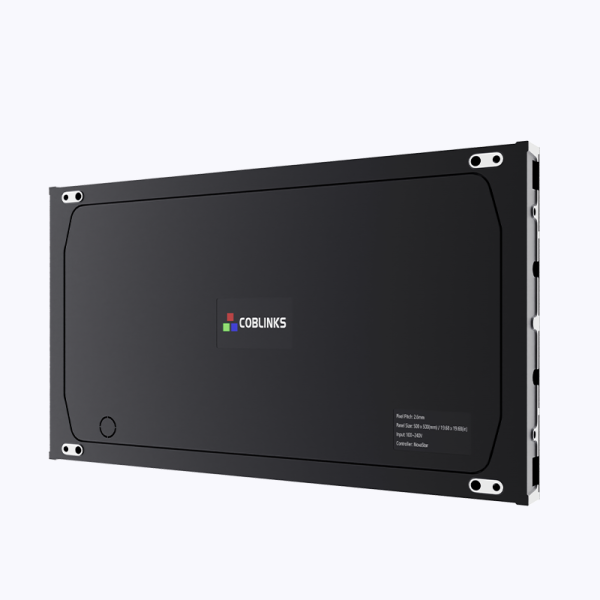
Final judgment rests on integrated value: a system that matches pixel pitch to venue, that supports robust color calibration, and that provides clear service access will reliably elevate visual experience—Coblinks.
—