
Table of Contents
A sourcing note on 3D Printer Chamber Heater: organize the review around assumptions for early research
Early research becomes difficult when a 3d printer chamber heater is compared by wattage alone. Application engineers need a short record of the intended printer, material, chamber, and operating conditions before comparing candidates. The purpose at this stage is not to select a final part. It is to make the next technical conversation precise.

Set criteria before comparing candidates
Start with the printing task. Record the filament grade, part geometry, printer design, and whether the chamber is enclosed. Materials such as ABS, ASA, PC, and PA can benefit from an enclosed printing environment, but the need for active chamber heating depends on the material grade, part geometry, and printer design. This makes the application context more useful than a generic product label.
Next, write down the required chamber conditions. The review should include the target chamber temperature, acceptable temperature variation across the build area, and required warm-up time. These conditions should follow the material supplier’s recommendations and stay within the printer’s operating limits. Treat each value as a project requirement, not as a default specification for every printer.

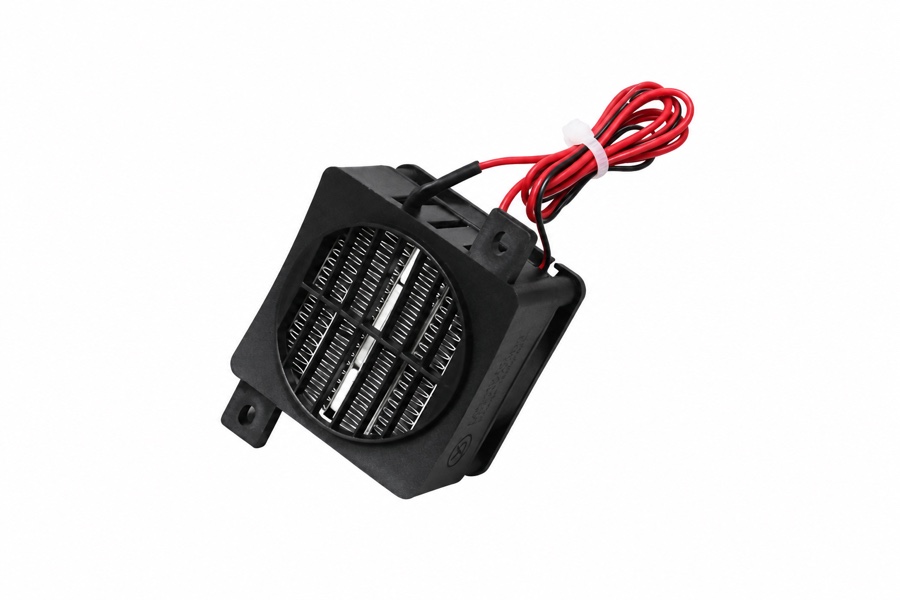
Space and supply conditions belong in the same first-pass record. Note the available installation space and supply voltage before asking for a configuration. One listed PTC fan heater has a voltage range of 12–220V, a wattage range of 70–400W, dimensions of 87.5 × 60 × 42/52 mm, and a built-in fan for air circulation. These details describe that listed product and should not be extended to other models without evidence.
Review evidence by requirement
A useful real-world anchor is the official application guidance for 3D printer heated chamber temperature. It tells the engineer to specify the target temperature, acceptable variation, and warm-up time, then relate those conditions to material recommendations and the printer’s operating limits. That is a practical boundary for early research: define the operating window first, then assess the heater against it.
Control should be recorded separately from heating capacity. The captured application information states that a temperature sensor and controller monitor chamber temperature and adjust heater operation to maintain the required setpoint. Therefore, a review should identify the sensing and control arrangement rather than treating the heater body as the complete system.
When the discussion turns to the 3d printer chamber heater core, keep the request tied to the actual chamber. Relevant inputs include chamber volume, target temperature, minimum ambient temperature, insulation, airflow, heat loss, and required warm-up time. The page states that wattage alone does not determine chamber performance. A higher number without the surrounding conditions is not a complete comparison.
Keep trade-offs visible
Separate confirmed details from working assumptions in the review document. Confirmed details can include a listed voltage range, wattage range, size, or built-in fan. Working assumptions might include the chamber volume, ambient temperature, or expected warm-up requirement until the project team supplies them. This separation prevents a preliminary comparison from appearing more certain than it is.
Also keep the physical installation question visible. A conductive PTC fan heater is described with a black protective grille, mounting tabs, and red and black wires. Those are useful points for discussing the physical configuration, but they do not by themselves establish suitability for a particular printer. The installation conversation still needs the available space, supply voltage, and heating requirements.
| Requirement | What to record | Evidence boundary |
|---|---|---|
| Chamber conditions | Target temperature, acceptable variation, and warm-up time | Follow material recommendations and printer operating limits |
| Control arrangement | Temperature sensor and controller | Monitor chamber temperature and adjust heater operation |
| Heater selection | Volume, ambient temperature, insulation, airflow, heat loss, and warm-up time | Wattage alone does not determine chamber performance |
Create a repeatable decision record
Use the same sequence for every candidate. First, state the material and printer context. Second, list the chamber temperature, variation, and warm-up requirements. Third, record the space and supply constraints. Fourth, map each available product detail to one requirement. Finally, mark unresolved points as questions for the next engineering discussion.
| Requirement | What to record | Evidence boundary |
|---|---|---|
| Chamber conditions | Target temperature, acceptable variation, and warm-up time | Follow material recommendations and printer operating limits |
| Control arrangement | Temperature sensor and controller | Monitor chamber temperature and adjust heater operation |
| Heater selection | Volume, ambient temperature, insulation, airflow, heat loss, and warm-up time | Wattage alone does not determine chamber performance |
This record also makes unsuitable comparisons easier to remove. A product with a convenient published size may still require a different chamber assessment. A stated wattage may still be difficult to interpret without volume, insulation, airflow, ambient temperature, heat loss, and warm-up time. Keeping those conditions together reduces the risk of choosing from one number.
The result is a disciplined early-stage brief rather than a premature purchasing decision. It connects the intended use and installation space to page-listed evidence, while preserving the assumptions that still need engineering review. For a focused discussion about supply voltage, installation space, and heating requirements, PTCYIDU can be included as the named source of the captured PTC heating application information.
