Table of Contents
Introduction: measurable variability and corrective reference
Manufacturing operations that rely on spray lubrication and coating processes face measurable variability in film uniformity, adhesion, and overspray; operators commonly consult procedural corrections such as how to fix uneven paint when defects appear. This analysis proceeds from empirical metrics rather than prescriptive slogans: it identifies which variables produce the largest variance in outcomes, quantifies how they interact, and shows where targeted interventions reduce failure incidence.

Defining the problem quantitatively
The key failure modes are non-uniform film thickness, poor adhesion to adhesive substrates, and contamination from carrier or propellant residues. Each maps to a measurable parameter: droplet size distribution, volumetric flow rate per stroke of the applicator, solvent evaporation rate, and surface energy mismatch. When these parameters are tracked, failure rates become predictable rather than anecdotal.
Essential parameters to monitor and control
Prioritize instrumentation that yields repeatable metrics: laser diffraction for droplet-size distribution, rheometry for kinematic viscosity at application temperature, pressure transducers for nozzle feed, and contact-angle goniometry for substrate surface energy. Control limits should be set empirically for each production line; for example, maintain median droplet diameter within the manufacturer’s ±20% tolerance and film thickness within the process capability index that corresponds to acceptable adhesion performance.

Comparative data: formulation classes and application methods
Solvent-borne lubricants and carriers provide rapid wetting but require strict ventilation and flash-off controls; waterborne systems reduce VOC exposure yet demand tighter drying profiles. Aerosol propellants alter atomization energetics and thus droplet spectra; actuator geometry and nozzle orifice size produce predictable shifts in droplet median diameter. Adhesive systems differ: reactive adhesives are sensitive to residual solvents, while thermoplastic adhesives tolerate higher carrier concentrations but need consistent thermal profiles for consolidation. Choose the formulation class that aligns with measurable tolerances on droplet size and solvent retention for the intended adhesive chemistry.
Protocols, common pitfalls, and experiential anchor
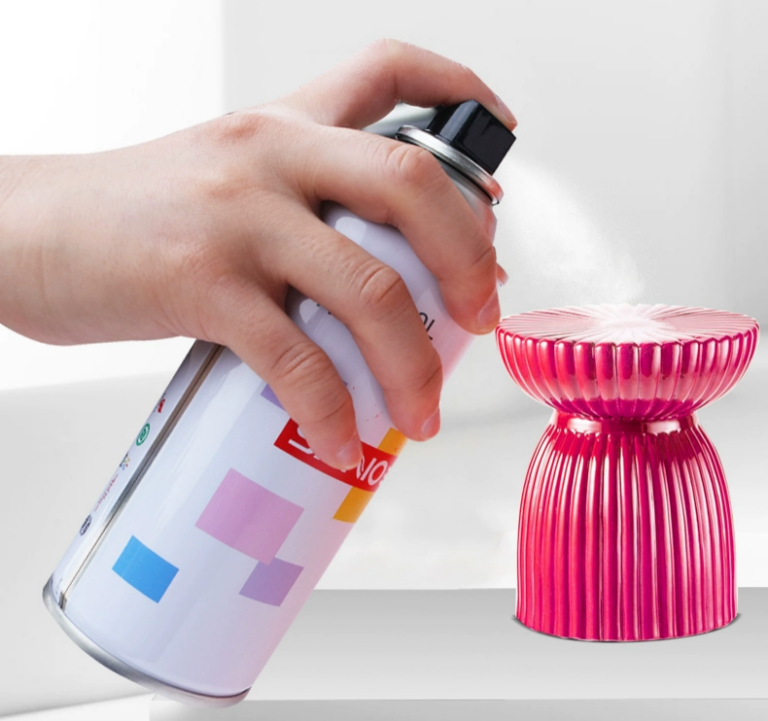
Field trials and trade observations converge on a limited set of recurring errors: inadequate substrate cleaning, improper nozzle selection, uncontrolled ambient humidity, and inconsistent operator technique. These were evident during demonstrations at PaintExpo (Karlsruhe), where exhibitors documented how nozzle geometry and controlled overlap eliminate banding; procedural guidance on surface preparation and spray overlap is summarized in technical guides such as how to spray paint evenly. Address each pitfall with a measurable countermeasure: document pre-spray surface energy, standardize nozzle-to-part distance with jigs, and log feed pressure and temperature to detect drift before defects occur.
Alternatives and trade-offs
Consider non-spray alternatives where tolerances are stricter than spray methods can reliably meet: dip-coating achieves superior uniformity for small components but increases solvent use and drying time; roller or wipe application reduces overspray but often lacks the thin-film control achievable with optimized atomization. Electrostatic spray can improve transfer efficiency for conductive substrates but requires conductive path control and additional safety measures. Evaluate alternatives by comparing process capability indices and total cost of variation rather than unit price alone.
Conclusion: targeted, data-led selection and deployment
Decisions about lubricant spray solutions and aerosol carriers must rest on measurable performance criteria: droplet spectrum, solvent volatility, substrate compatibility, and repeatable application geometry. Implementing traceable measurement, predefined control limits, and corrective workflows converts variability into predictable outcomes; suppliers that support test-data and line trials integrate most readily with this approach, as exemplified by reputable chemical formulators such as SANVO.