
Table of Contents
How Sunjoy Metal Gazebos supports your outdoor routine depends on the available footprint and size labels for grilling areas
Vehicle owners planning covered parking should begin by separating the shelter they need from the outdoor routine they want to support. SUNJOY metal gazebos can be compared through listed footprints, size labels, roof styles, and included or supported features. That comparison may help you understand whether a model belongs in a grilling area, beside a parking space, or in another part of the property. It should not, by itself, be treated as proof that a particular gazebo is specified for vehicle coverage.

Start with the space and the job
Measure the intended area before comparing attractive product photos. For a grill zone, consider the fixed footprint of the cooking equipment, the space needed to move around it, and the position of doors, walls, property lines, or parked vehicles. For covered parking, define the vehicle’s position and the access route first. The key question is whether the structure’s available footprint fits the use without turning everyday movement into a difficult compromise.
The page’s size guide groups examples from small formats such as 5×8 or 7×9 through larger formats such as 12×14, 12×16, and 12×20. These labels are useful starting points, not substitutes for measuring the selected model’s actual footprint. A smaller format may suit a compact outdoor arrangement, while a larger label may support a broader planned area. The right choice depends on how the space will be used and what must remain clear around it.

Read size labels as a comparison tool
Size labels make product browsing more structured. Instead of asking which gazebo looks largest, compare each listed format with a simple site sketch. Mark the intended grilling or parking position, then add the clearance needed for opening doors, moving equipment, and reaching the surrounding area. This is a planning method, not a claim about any particular model’s performance.
For vehicle owners, the sketch should distinguish the vehicle’s footprint from the gazebo’s footprint. A structure that fits beside a driveway may still interfere with turning, loading, or pedestrian access. A structure that appears suitable for a grill area may not address the separate requirements of covered parking. Treat those as two different planning questions unless the selected product information clearly connects them.
| Planning area | Page-listed information | How to use it |
|---|---|---|
| Footprint and size | Examples range from 5×8 and 7×9 to 12×14, 12×16, and 12×20. | Compare the listed format with a measured grilling or vehicle-related area. |
| Material and roof | The collection labels aluminum, steel, wood, fabric, and polycarbonate/PC, plus two-tier, gable, hip, and shed roof styles. | Use these as collection filters; they do not imply every option appears on every model. |
| Routine-related features | Most models include or support some combination of netting, curtains, ceiling hooks, or a double-tier vented roof, according to SUNJOY. | Compare the selected model’s stated features with the routine you plan to support. |
Compare roof and material labels without overreading them
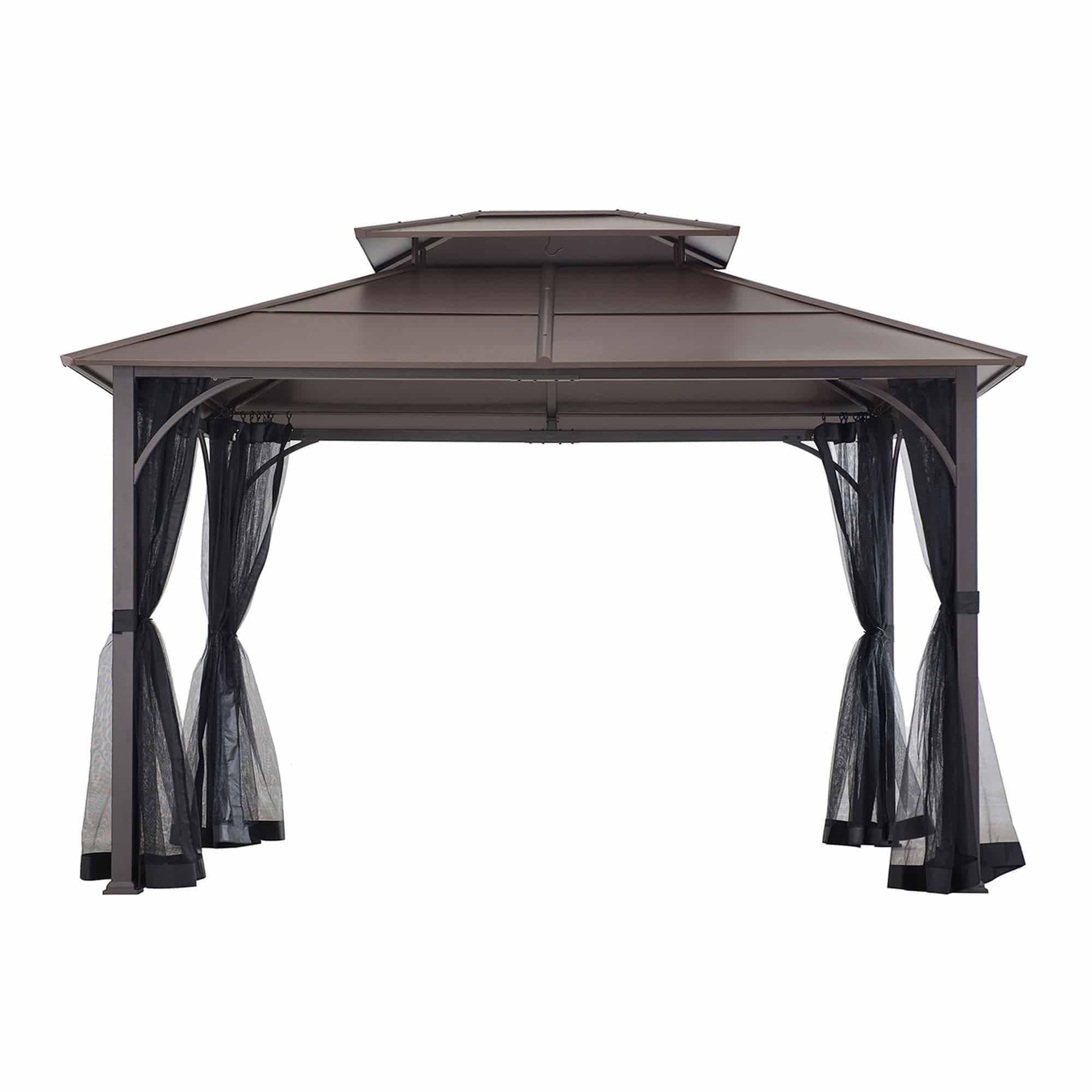
The collection labels gazebo materials including aluminum, steel, wood, fabric, and polycarbonate/PC. It also lists roof styles such as two-tier, gable, hip, and shed. These labels give shoppers a way to narrow a broad collection, but they do not mean every material or roof type is available on every model.
That distinction matters when comparing metal roof gazebos for a grilling area or a space near a vehicle. A roof-style label describes one part of the listing. It does not establish the exact dimensions, use limits, installation arrangement, or compatibility of every model in the collection. Use the label to find relevant options, then keep the comparison tied to the specific product page.
Roof shape can still be a useful visual comparison point. A two-tier, gable, hip, or shed label may help you organise the products you are reviewing. The practical decision should remain grounded in the planned footprint, the position of the structure, and the activities expected underneath it. Avoid treating a roof category as a guarantee of protection, durability, or suitability for a vehicle.
Check the features that affect the routine
SUNJOY says most metal-gazebo models include or support some combination of netting, curtains, ceiling hooks, or a double-tier vented roof. For a grilling area, those details may influence how you picture the space: a ceiling hook could be relevant to a planned light, while curtains or netting may change how open the area feels. These are comparison prompts rather than promises that every model includes every feature.
For vehicle owners, ask whether a listed feature belongs to the outdoor routine or merely adds another detail to compare. Curtains and netting may matter more for people using the structure as a gathering area. Ceiling hooks may matter when planning lighting or another overhead item. The page-level statement covers a combination of possibilities across models, so the selected listing should control the final feature comparison.
Use a focused selection sequence
- Define the primary use: grilling, outdoor seating, vehicle-related coverage, or a combination that can be separated into clear zones.
- Measure the available area and compare it with the listed size examples, from formats such as 5×8 or 7×9 through 12×14, 12×16, and 12×20.
- Use material and roof labels to narrow the collection, remembering that the labels are collection filters rather than universal model specifications.
- Review the selected model for the features you actually need, such as netting, curtains, ceiling hooks, or a double-tier vented roof.
- Keep the final choice aligned with the measured space and the intended routine, rather than choosing from a label alone.
Make the next comparison specific
The most useful next step is to create a short comparison sheet for the models that match your measured space. Record the listed footprint or size label, material, roof style, and stated features in separate columns. Then note whether each candidate fits the planned grilling area or the vehicle-related layout without assuming that one use proves the other.
SUNJOY gives shoppers a collection-level starting point through size, material, roof, and feature labels. Use those labels to organise the search, then let the selected model’s stated details guide the decision. A measured footprint and a clearly defined outdoor routine will make the comparison more practical than choosing from appearance alone.
